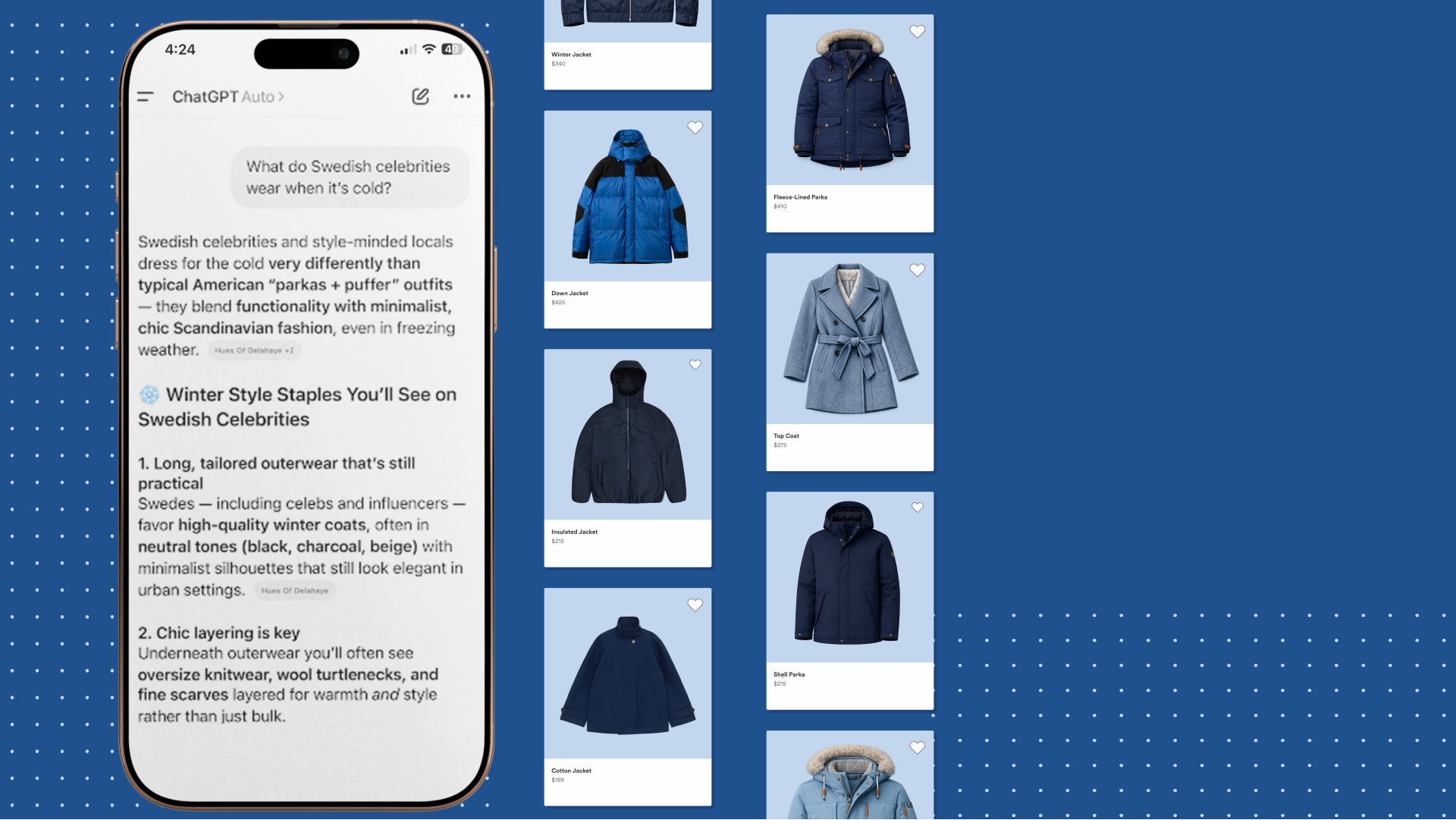
Earlier this month, I shared a post where I asked ChatGPT what Swedish celebrities wear in the cold. It gave me a great answer: Acne Studios, Rains, ARKET, 66°North. Exactly the vibe I was going for.
Then I asked for something simple. Specific links. Size small. Down only. Check what's in stock.
It came back with Nordstrom, tentree, and Quince. Not one of the brands it had just recommended.
When I pushed back, ChatGPT was surprisingly candid about why. It can't access retailer inventory databases. It can only read publicly indexed pages. Many designer sites block that indexing, run JavaScript storefronts that search tools can't parse, or sell exclusively through department stores without a single canonical product page.
So the brands it knew were right for me were the exact brands it couldn't help me buy.
ChatGPT winter coat recommendations (PDF). Opens in a new tab — best on a larger screen.
View PDFThen a More Capable Agent Tried the Same Task
Here's where it gets interesting.
Last week, I shared that someone on the FindMine team built themselves a productivity agent and gave it a lot of autonomy. The whole point of the project is to test how much useful work an agent can do when you let it identify tasks on its own rather than waiting for explicit instructions.
During one of our internal calls, I mentioned I'd been trying to use ChatGPT to find a winter coat, and the experience wasn't great. I didn't ask anyone to do anything about it.
But the agent picked up on it, decided the task was worth pursuing, researched coat options independently, and sent me a detailed recommendation document. That part was genuinely impressive, and exactly the kind of autonomous task it was designed for. The agent identified a problem, scoped the research, and delivered a structured output: comparison tables, sustainability certifications, price breakdowns, and ranked recommendations. It looked like someone had spent hours on it.
Agent winter down coat recommendations (PDF). Opens in a new tab — best on a larger screen.
View PDFBut here's what matters for the brands-and-data argument: when I dug into the details, I found the same failures I'd hit in my own ChatGPT search: Heavy reliance on physical product attributes but entirely missing the CONTEXT - the vibe I am going for is Swedish celebs in the cold, or at the very least staying stylish in the cold. Interestingly, the 2nd agent included a "vibe" column but got totally confused about what the vibe was supposed to be (in my 1:1 with my colleague, we had talked about Carolyn Bessette Kennedy, but in a completely unrelated conversation to the one about my coat search).
Two different AI systems. Very different levels of sophistication. The exact same failure mode.
As Cher Horowitz would say, it's a Monet. From far away, it's OK. Up close, it's a big old mess. The agent did a thorough if not slightly random job. The product data underneath it was missing the CONTEXT that I was looking for.
One more thing that made me laugh: at the end of its recommendation doc, the agent wrote, "If I were buying against your brief with my own money..." My first reaction was you don't have any money, you're not real. But my colleague has been experimenting with giving agents a budget to spend on things they "want" (digital art, game tokens, etc.), so that line actually carried some weight. We're living in strange times.
Two Structural Problems Hiding Behind a Coat Search
The coat experiment was funny. The underlying problems it exposed are not.
The platform puts the burden on the brand.
ChatGPT and other LLMs can check in-stock sizes and color availability on product pages. It just costs compute and engineering effort to do so, so it doesn't by default. That shifts responsibility entirely to the brand: if your product data isn't clean, structured, and publicly indexable, these tools skip you. Silently. Without telling the shopper why.
Most brands don't have the content to be found in the first place.
Acne Studios and Rains weren't missing from my shoppable results because their products are wrong. They were missing because they don't have pages built for the kind of query I was running. No editorial content around "stay stylish, stay warm." Nothing about "dress like a Swedish supermodel this winter." Nothing an AI agent could latch onto and connect to a purchase.
And here's the math problem: brands can't manually create that content for every query consumers run. "What should I wear to Lady Gaga?" "Help me update my skincare regimen for my 40s." "Help me plan a Kentucky Derby party." Each of these is a real shopping moment. Most brands have zero content that answers any of them.
This isn't a technology failure. It's a CONTEXT gap.
What to Actually Do About It
If you're a retailer reading this and thinking "okay, so what now," here's how I'd think about the problem across three time horizons.
Now
Immediate visibility in AI search
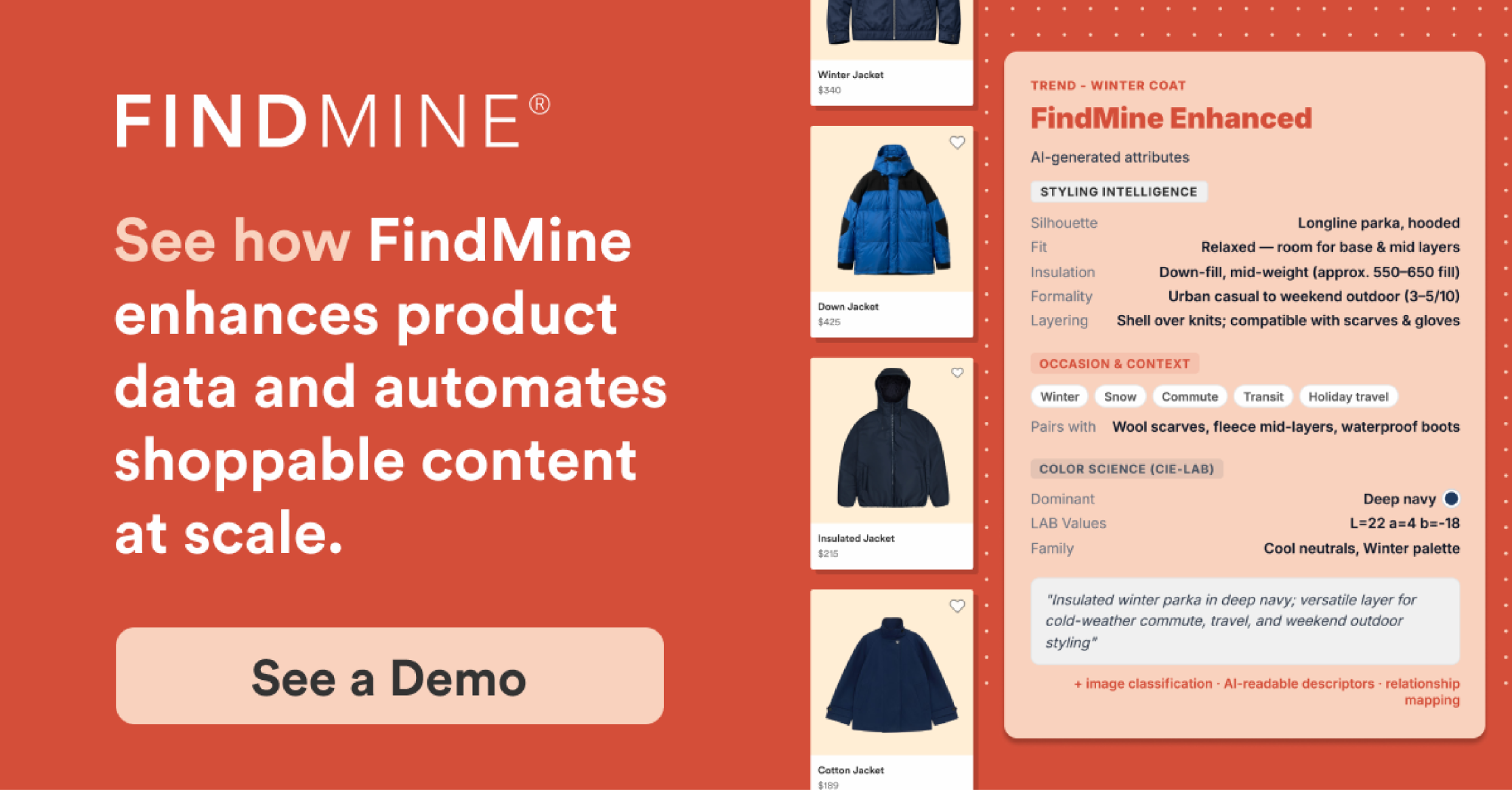
Make your product content machine-readable for LLMs. Not just the thing EVERYONE is already talking about and trying to sell you: structured data, clear physical product attributes, and pages that don't rely entirely on JavaScript rendering to surface information. But you must also ensure that CONTEXT keywords are present (what kinds of celebs would use this? what occasions could this be used for? what's the vibe? what decade is this most closely aligned with? what's relevant trends does this hit on?). This is the bare minimum, and most brands haven't done it yet.
Mid-term
Competitive advantage
Build content that answers the questions shoppers are actually asking AI agents. Not just product pages. Editorial content. Trend-driven content. Occasion-based content that connects your products to real intent. The brands that have a page answering "what to wear to a winter wedding in Stockholm" will get surfaced. The brands that only have a product grid will not.
Long-term
Differentiation
Automate the creation of that content. The math simply does not work if every trend, micro-moment, and audience segment requires a manual editorial process. You need systems that understand your catalog, your brand rules, and your inventory in real time, and can generate shoppable content at the speed consumers are searching.
FindMine is built for this: connect catalog, brand rules, and live inventory to generate on-brand, shoppable content at the speed shoppers search, without the manual editorial bottleneck.
Request a DemoIn January of this year, 58% of consumers now start product discovery with AI tools, according to Retail TouchPoints. In February, that number rose to 64% (AB Newswire). That number is only moving in one direction.
The Real Threat Isn't Your Competitor
The brands that aren't showing up in AI-powered shopping conversations aren't losing to rivals with better products. They're losing to invisibility. The recommendation happens, and they're not in it. The agent goes looking, and there's nothing to find.

Michelle Bacharach is the CEO and Founder of FindMine, an AI platform that helps enterprise retailers build the content infrastructure their brands need to show up in search, in AI-powered shopping, and at every point a customer is ready to buy. Top brands use FindMine to automatically generate on-brand, inventory-aware curation and creative at scale (100M consumers a month see FindMine's content). With 15 years of product leadership at the intersection of retail and technology, Michelle has become one of the more direct voices on what it actually takes for brands to compete in an AI-first commerce environment, speaking at National Retail Federation's Big Ideas Keynote, SXSW, and HumanX, and appearing in Forbes, Vogue Business, and Daily Women's Wear. She is an Inc. Magazine Top 200 Female Founder and holds the Retail TouchPoints 40 Under 40 distinction.