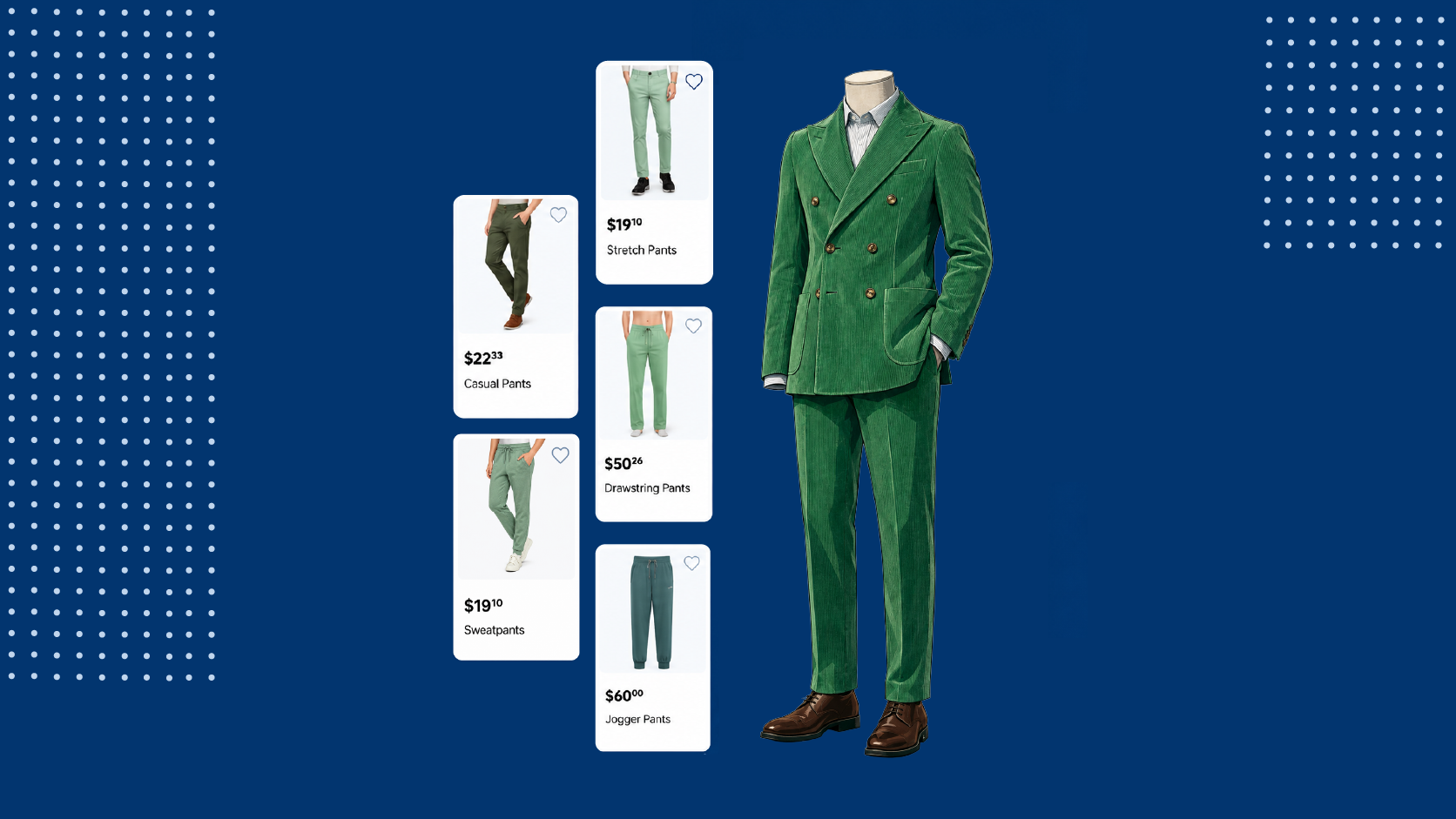
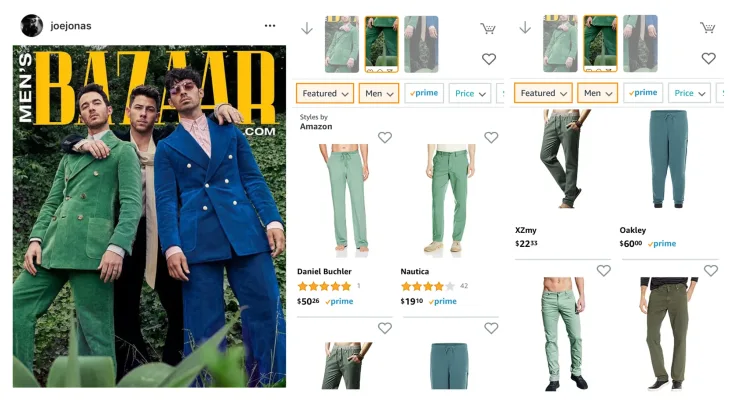
When Amazon launched StyleSnap in 2019, they announced it would "change the way you shop, forever." The tool let you upload a celebrity photo, and then it would find similar items for sale on Amazon. Impressive premise. So someone uploaded a photo of a Jonas Brother wearing a flashy, green-textured suit… the kind of look that requires coordinated intent from head to toe. StyleSnap's top recommendation for the bottom half: sweatpants.
The tool had technically done its job. It found bottoms. It found bottoms that were available on Amazon. It looked at the green textured suit and came back with sweatpants and declared: outfit complete.
Anyone who knows fashion looked at that and threw up in their mouth a little.
The Completeness Trap
I think about that StyleSnap demo a lot because, despite it being 7 years later and with some really incredible AI advancements in that time, most AI stylist applications and recommendation engines are still stuck in what I call the completeness trap.
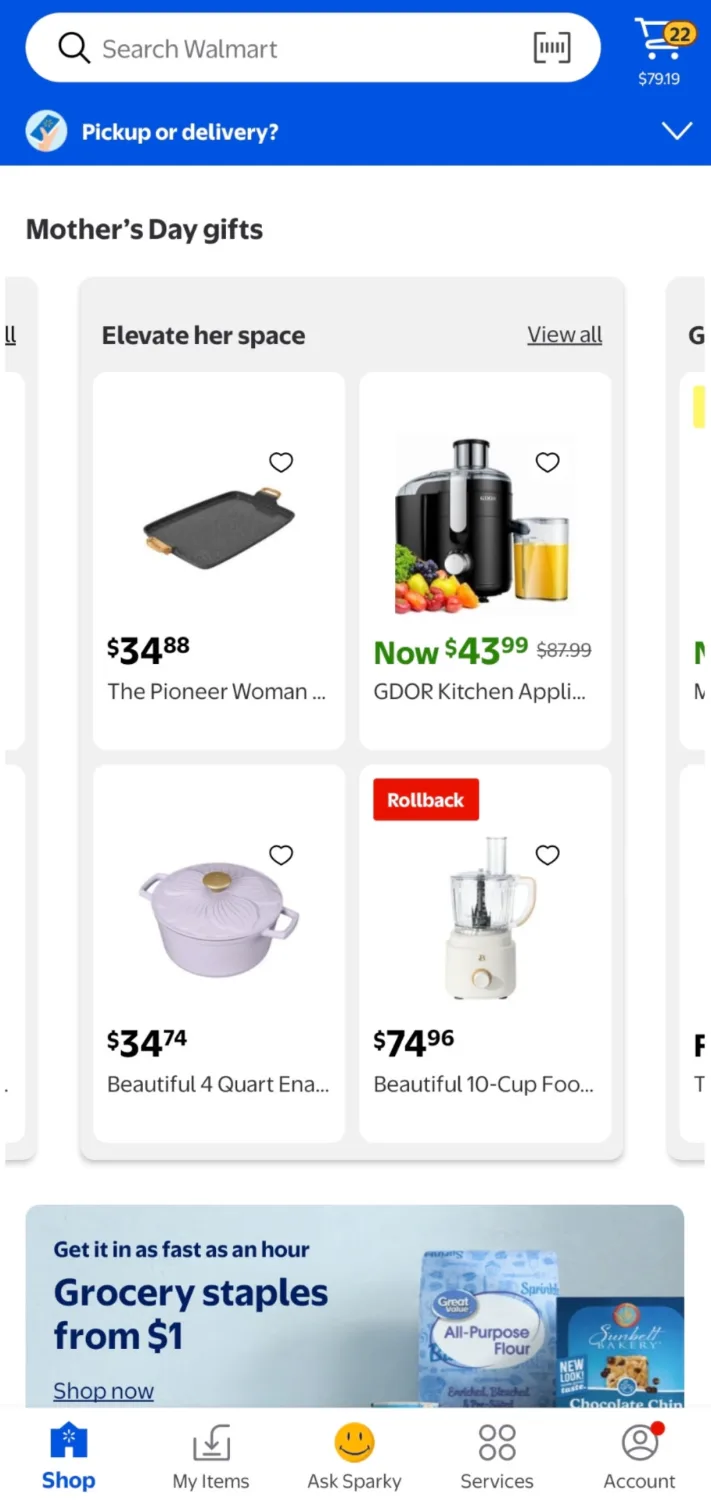
A very current version of this showed up recently in a curated Mother's Day gift carousel. In a carousel labeled "Elevate her space," the products were almost entirely kitchen items.
Now, I don't know about you, but as a mom, I cringed at this. Elevating my space to me might mean things to turn my bathroom into a spa experience, stuff to make a She Shed (also cringe, but I kinda want one), give me a cozy reading corner, etc., not "help me do my chores easier" or make assumptions about my household responsibilities. Even with something as simple as another heading, like "For the Culinary Enthusiast," it wouldn't have felt tone-deaf. Technically, the system did what it was asked to do: it filled a gift carousel with products that could plausibly live in a home. But culturally and contextually, it missed the point. That's the completeness trap in a different outfit: the recommendation is technically complete, categorized, and probably defensible by metadata, but it carries a message most thoughtful brands wouldn't want to send.
How the Completeness Trap works
The completeness trap goes like this: your AI identifies a hero product on a product page, scans the catalog for coordinating items, assembles a look with a shirt, pants, a shoe, and maybe a bag, and marks the ticket done. The engineer's dashboard shows green. Coverage is up. Outfitting is automated. Someone writes a press release.
And then a merchandiser or a buyer walks over, looks at the screen, and has that stomach drop. Because there's a silk blouse sitting next to a hiking boot. There's a cocktail dress paired with weekend athleisure socks. There's a beach cover-up in a back-to-school September capsule. Not because the AI made a mistake by its own logic; they're technically categorized correctly.
The AI just has no idea about COHERENCE.
Completeness vs. Coherence
Here's the distinction that gets lost in every "we're launching an AI stylist" announcement: there is a difference between completeness and coherence.
Completeness
Completeness is easy. Completeness is: does this look have all the required item categories? Shirt, check. Bottom, check. Shoe, check. Done. Any engineer can build completeness. It's a categorization problem, and AI is very good at categorization.
Coherence
Coherence is something else entirely. Coherence is: Does this make sense? Not just visually (though color, proportion, and scale all matter!) but contextually. Is this how someone actually gets dressed for this occasion? Does the level of formality hold across all items? Does this look reflect the brand's point of view, or does it look like it was assembled by a competitor? Or worse, someone who has never once thought about what to wear?
Coherence requires knowing that a silk slip dress and a puffer jacket can absolutely go together, but only if you understand the current aesthetic. It requires knowing what "cozy season" is and actually looks like at this brand, not at every brand simultaneously.
Generic AI doesn't know any of that. It doesn't know because no one told it. You can give ChatGPT or any base model your entire product catalog and ask it to build outfits, and it will do so confidently and continuously, without the hesitation a good stylist or well-trained merchant would feel before pairing the wrong things together.
"AI is really powerful but can be incredibly stupid."
I've been saying that for years. The StyleSnap sweatpants problem never went away.
Good enough is the real enemy
Our CTO likes to tell the story of watching the Gerhard Richter documentary: He's watching this guy smear layer after layer of paint on a canvas. The artist pauses at a point when there's a lot of paint layers already, and it looks pretty good (…to you!). Then he smears a pile of brown on top, and you think, "Oh no, you ruined it!" He keeps going. Layer after layer. Until HE thinks it's done. Then and only then you realize, "Oh yeah, that is better."

PMs and Engineers are the documentary viewers. The definition of done is just different for the stylist, the visual merchandiser, and the marketing creative.
The part that worries me isn't the obviously bad output. The obviously bad output gets caught. A PM vibe codes a virtual stylist. Someone with the fashion eye sees the silk blouse with the hiking boot and flags it immediately; the demo gets pulled, lesson learned.
What worries me is the mediocre output that passes. The look that's technically fine. The outfit that no one in merchandising would sign off on as great, but that doesn't rise to the level of obvious error. The recommendation that's sensible enough that it doesn't get flagged, but that would never appear in any brand's editorial (because it's nobody's aesthetic). It's the average of everything the AI has been trained on, applied to your brand's catalog, flattened into something generic and harmless.
That's what most retailers are actually shipping. Not the sweatpants-with-a-suit disaster. The look that just... doesn't feel like you.
And here is the thing: your customer will feel that even if they can't articulate it. The items feel like they were grabbed from the catalog rather than curated for her. She's not going to write a tweet about it. She's just not going to click.
The actual fix is prompting, but therein lies the issue
So what's the actual fix? How do you even describe coherence in words anyway? LLMs use human language for you to communicate with them, but much of art, taste, and style isn't reducible to human language in the first place. If an AI stylist is supposed to save human stylists' time, but they just shifted all their time instead into banging their head against a wall until they get a prompt for a trend or look just right to get the desired output, what's the point?
The missing layer is the translation from the creatives' brains to something a model can actually act on. And it's the reason the first 80% of the AI stylist can be built in 4 days, but the last 20% takes 3 years to get right (and then constantly needs updating).
The prompting is also a source of peril when too many cooks are in the kitchen, a common issue in retail, especially when it's something as exciting and fun as AI styling! Everyone wants in on the project, every merchant has their own category to look after, and everyone's thumb is on the scale in a different way. Different visions of what actually is on brand, fights between teams with the tech caught in the middle.
We've seen AI so over-managed that execs would complain about outfit quality only to find out it was a manually curated look by one of their own team members. There was no prompt, just intentionally put-together items that conflicted with someone else's standard of on-brand. And you can certainly teach the AI bad habits with these wayward (to some) manual inputs.
Getting the last 20% right isn't a technology problem. It never was. More on that in my next newsletter!

Michelle Bacharach is the CEO and Founder of FindMine, an AI platform that helps enterprise retailers build the content infrastructure their brands need to show up in search, in AI-powered shopping, and at every point a customer is ready to buy. Top brands use FindMine to automatically generate on-brand, inventory-aware curation and creative at scale (100M consumers a month see FindMine's content). With 15 years of product leadership at the intersection of retail and technology, Michelle has become one of the more direct voices on what it actually takes for brands to compete in an AI-first commerce environment, speaking at National Retail Federation's Big Ideas Keynote, SXSW, and HumanX, and appearing in Forbes, Vogue Business, and Daily Women's Wear. She is an Inc. Magazine Top 200 Female Founder and holds the Retail TouchPoints 40 Under 40 distinction.