
A FindMine investigation into the silent revenue killers hiding on your product detail pages
We audited over 100 fashion sites, comparing them against industry benchmarks, and discovered a concerning trend: nearly every major retailer has at least one catastrophic recommendation failure live on their PDP in ecommerce right now. Not buried in some dusty corner of the catalog, but on their hero products. Their bestsellers. Their homepage features.
Consider a men's denim product detail page that recommends floral blouses. "Similar items" that are neither similar nor items anyone would want. Empty recommendation slots. These aren't edge cases. They're likely on your highest-traffic ecommerce product pages.
The Real Cost of Being Basic
If your rec engine is stuck on "You Might Also Like," it's quietly torching a portion of your P&L.
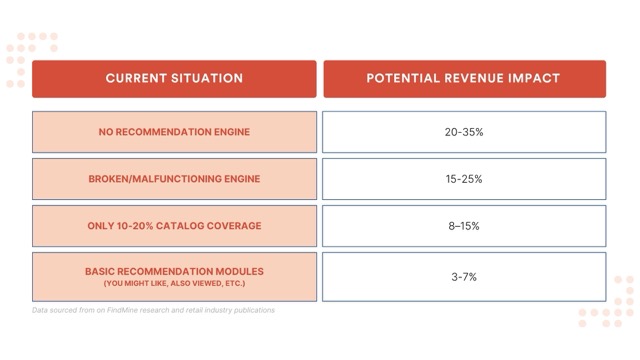
Why those percentages matter:
- No engine? You forfeit the entire lift recommendations deliver. Salesforce's study of 150 M sessions shows that rec-clickers convert 4.6× higher and drive 26% of revenue.
- Broken logic? Misfiring rails erode trust; irrelevant or repetitive recommendations make users tune out the module entirely, killing the upside.
- 10 – 20 % coverage? That's the industry norm for legacy systems, meaning 80% of your catalog never gets surfaced, stifling discovery and full-price sell-through.
- Basic similarity-only widgets? They capture only a sliver of the possible lift because they ignore style context, margin strategy, and inventory + sizing reality.
Do the math: A brand doing $100M online that's stuck at "basic" leaves $5M on the floor every year. Worse, those dollars flow straight to competitors who do inspire shoppers. Understanding these key performance indicators in ecommerce is crucial for measuring the real impact.
True story: A retailer using FindMine's AI content engine on their PDPs drove +20% of its e-commerce revenue from styled looks, while conversion and demand-per-visitor climbed by over 8x.
The Five Ways Your PDP in Ecommerce Is Betraying You
These broken recommendation strategies are costing retailers millions in lost revenue.
Disaster #1: The Color Blindness Crisis
True story: Your product display page shows a "black" hero product, but the "more like this" rail is full of brown. That disconnect happens when marketing color names don't match PIM attributes. The GS1 standard even includes an "Alternative Colour Description" for exactly this reason, because marketing names like "Midnight" often need to map to a normalized color value.
What it breaks:
- Variant confusion drives abandonment. Many sites don't sync product data across color variants or update thumbnails to match the color the shopper searched for, which hurts product finding and purchase decisions.
- Shoppers return more when items don't meet expectations, and wrong size/fit/color is a leading reason for returns.
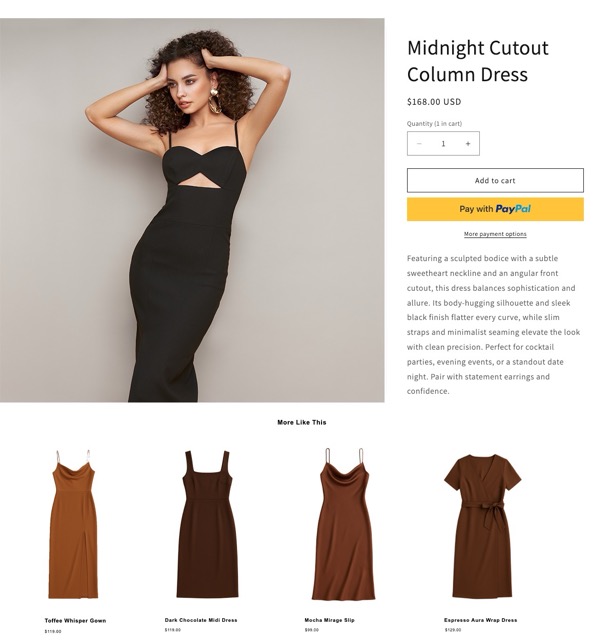
Quick fix: Audit your top sellers for color consistency across PIM and site copy. If you use marketing names, also store a normalized color and ensure thumbnails, swatches, filters, and recommendations all reflect the same value. The GS1 color codes exist to align this across systems.
FindMine's solution: We use your catalog feed and product attributes as the source of truth for styling. We ingest and normalize attributes (like color and category) on a regular cadence, then apply your brand's rules to keep pairings consistent in the recommendations. When you provide mapping tables or controlled vocabularies (for example, color IDs or a "basic colors" list), we apply those so shoppers see consistent labels in rec modules. We don't infer unlabeled details like prints unless the feed includes them. Our AI-powered recommendations eliminate the manual work that causes these failures.
Disaster #2: The Gender Chaos Catastrophe
A shopper lands on a men's jeans ecommerce product page. Your "You Might Also Like" rail shows women's jeans and blouses. That's a fast way to lose trust and the session.
What actually happened: Sites often infer "gender" from clickstream alone. The problem is that a large share of shoppers browse anonymously and won't log in, which makes behavior-only inference unreliable. Retail Dive reports that roughly 90% of site traffic is anonymous on many retail sites, and consumer surveys show nearly half of shoppers avoid creating an account or delay login until checkout.
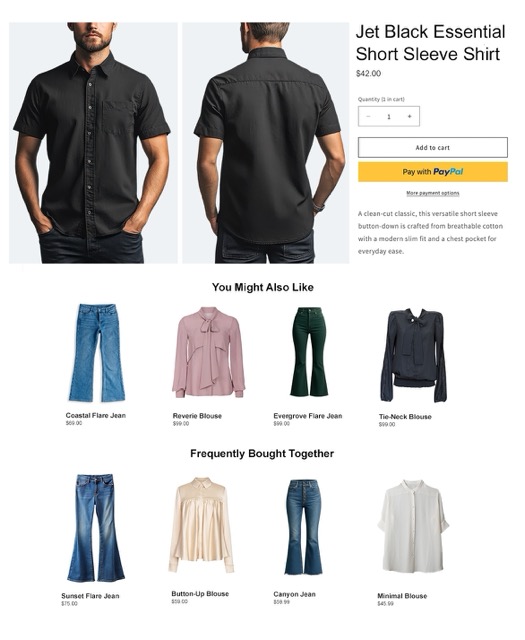
Why this matters: Mis-targeted recommendations erode relevance and drive abandonment. Large-scale UX research from Baymard shows users quickly dismiss recommendation modules when they aren't obviously relevant to the current product or audience, and many sites still display irrelevant or poorly labeled cross-sells on PDPs and in the cart.
Standards say this should be preventable: Apparel data standards include attributes for Target Consumer Gender and Target Consumer Age, precisely so sites can keep merchandising and recommendations aligned with the intended audience. GS1's Global Data Model and related code lists define these fields for use in PIM and downstream channels.
The damage (what the research supports):
- Irrelevant recs reduce engagement. When product suggestions don't obviously relate to the item in view, shoppers ignore them or give up on the module entirely.
- Personalization quality affects conversion. McKinsey finds 71% of consumers expect personalized interactions and 76% get frustrated when they don't get them. That frustration shows up as lower conversion and loyalty.
- Relevant recommendations can perform multiples better than baseline. A Salesforce study found recommendation clickers converted ~4.6× higher than non‑clickers across 150M sessions. Use this as a directional benchmark, not a guarantee.
Quick fix: Audit your top PDPs for audience alignment. Spot check that "men's" pages only show men's items across "similar," "complete the look," and cart cross‑sells, and that labels explain why items are shown. Clear labels and relevance are key to avoiding user distrust.
FindMine's solution: Our AI content engine enforces styling and eligibility rules from your catalog attributes. If a product is scoped to Men, we can restrict alternatives and complements on Men's PDPs to Men's items, and allow Unisex only when the catalog says so. Brands also use pinned exceptions for special cases. This automated styling approach prevents the gender chaos that manual processes often create.
Disaster #3: The Empty Wasteland
Your PDP is a ghost town, and your cross-sells have vanished into the void.
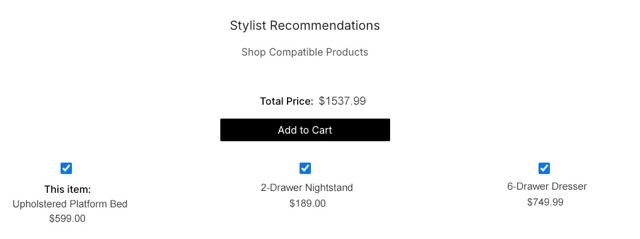
True story: Across many reatilers, we found dozens of new arrivals or flagship products sitting on PDPs with no recommendations or a lonely, spinning loader that stalled for 600ms before giving up. Those pages weren't just awkward; they were silently draining revenue.
What it breaks:
- Dead air where inspiration should live – Shoppers land on your PDP in ecommerce ready to be guided, but instead they see an empty rail. It feels unfinished, like walking into a boutique where the racks are bare.
- Revenue quietly bleeding out – Recommendations influence up to 26% of total e-commerce revenue, and shoppers who click them convert at 4.6× higher rates than those who don't. Every blank widget is money slipping through the cracks.
Quick fix: Audit your top PDPs, especially new arrivals and low-data SKUs. If a rec slot can't fill, backfill with trending or top-performing products so nothing renders empty. Poor product page design isn't just about aesthetics, and broken recommendations cost real revenue.
FindMine's solution: No empty rails. We generate rule‑compliant recs for every PDP, including new arrivals and low‑data items. If primary picks are light or a call times out, we backfill with best sellers or in‑stock alternatives. You can weight depth or margin, but nothing that violates your rules will surface. Our AI automation ensures every product page has engaging recommendations.
Disaster #4: The Tunnel Trap
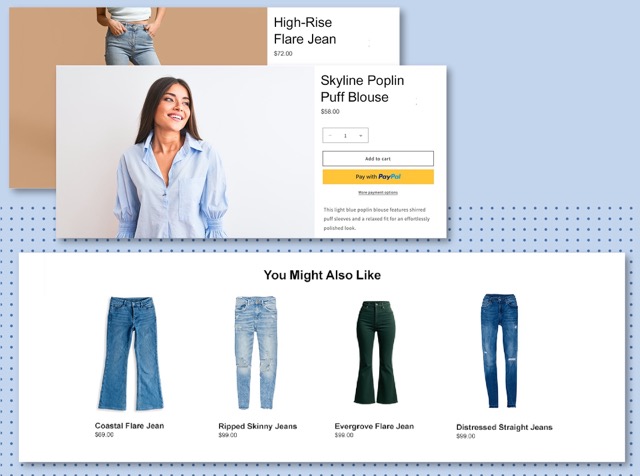
True story: In our sweep of 100-plus fashion sites, we kept finding the same pattern: jeans pages stuffed with more jeans, tops served nothing but near-identical tops, and the occasional head-scratcher that didn't match the vibe at all. When the rail stays in its bubble, shoppers never break out of theirs.
What it breaks:
- Discovery dead-ends – Only 42% of major e-commerce sites surface both alternatives and complements on the product detail page, so most users get stuck in a single-category loop, limiting exploration and inspiration.
- Trust (and spend) evaporates – Over half of sites show irrelevant cross-sells that shoppers quickly learn to ignore, eroding confidence in all recommendations.
Quick fix: Spot-check ten high-traffic PDPs. If a rail repeats the hero category more than twice in a row—or displays products with no style logic—add a simple rule: if category = pants, surface tops & footwear. Even that basic guard-rail breaks the tunnel.
FindMine's solution: No more category echo chamber. We combine complements and alternatives on the PDP, enforce category diversity, and keep everything on‑brand with your styling rules. If choices run thin, we backfill with rule‑compliant, in‑stock options. You can favor depth or margin in ranking, and items that fail your rules will never show. This Complete the Look technology breaks the tunnel vision that plagues basic recommendation engines.
Disaster #5: The "What Is That?" Problem
Your internal product names are poetry… but also completely useless in a 200px recommendation widget on your ecommerce product page.
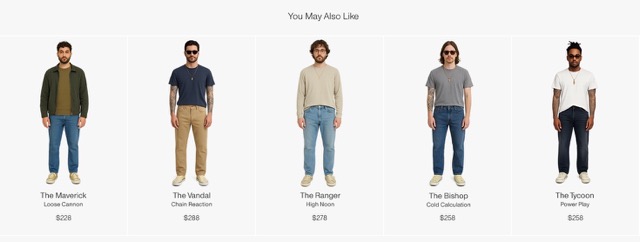
True story: In our sweep of 100-plus fashion sites, we kept hitting a wall of mystery names crammed into tiny recommendation widgets. Users had to open every item just to figure out whether something like "The Maverick" was a pair of pants or a cardigan.
What it breaks:
- Instant confusion. Baymard's large-scale testing shows users "ignore product suggestions that lack a fully visible product title," yet 55 % of sites hide or truncate titles in cross-sell widgets, forcing guess-clicks and frustration.
- Lost engagement (and tickets). When shoppers can't decode the offer, they skip the module—or ping support to ask. Retail UX researchers note that inadequate titles undermine the very purpose of PDP cross-sells: quick, low-friction discovery.
Quick fix: Keep the poetry on the product page hero, but feed your recommendation rail a short, descriptive alias (e.g., "Black Moto Jacket" instead of "The Rebel"). Most PIMs let you store both a marketing name and a functional name… use them.
FindMine's solution: We keep product titles clear in widgets. By default, we use the catalog name, not internal codes or UNIs. If your feed includes a shorter display name, we'll map that so "The Maverick" shows as "Black Moto Jacket." You control these settings in Admin, so shoppers can see what they're clicking without guessing. Our AI-powered recommendations ensure clear, descriptive product names that drive engagement.
Don't Let Another Session Slip Away
If you're still reading, you've already clocked the carnage: color chaos, gender mash‑ups, ghost‑town widgets, tunnel‑vision rails, and code‑name product titles that leave shoppers squinting. Each one is a pin‑prick to your conversion rate on evert PDP in ecommerce; together they're a slow bleed on revenue.
The 10-Second Reality Check:
🔴 Wrong colors in "similar items"
🔴 Gender chaos (men's pages → women's recs)
🔴 Ghost towns where recs should be
🔴 Recommendation tunnel vision
🔴 Product names that make zero sense
Patch one leak and you'll feel the lift. But keeping an entire catalog with 100s or 1000s of SKUs styled and bug-free is beyond human merchandising's power.
But here's the kicker: Only 17% of brands have figured out how to make AI recommendations work. The other 83%? They're leaving millions on the table.
FindMine's AI content engine can seal all five and turn your product detail pages into a living, breathing stylist… one that never sleeps, never ships the wrong vibe, and never shows brown when the shopper asked for black. Our Complete the Look technology transforms how retailers deliver personalized shopping experiences.
Want proof on your own turf?
Send us a high-traffic PDP and we'll return a personalized PDP audit that shows:
- Your current experience → coverage gaps, latency, and every rogue recommendation we can spot.
- A FindMine simulation → full‑catalog styling, on‑brand guardrails, and more inspiration for the customer.
Skip the theatrics. Get a fast, honest snapshot of how much revenue your PDP is losing and how FindMine's AI fixes it.
👉 Get My Personalized PDP Audit
See where you stand, what's leaking, and how to turn your product pages into revenue drivers without another late‑night scramble.