Every few weeks, someone in a very nice conference room tells me they're going to build it themselves.
It's always said the same way, with the same easy confidence. We have a great data science team. We have access to the same models you do. Why would we pay a vendor when we can stand this up in-house by Q3? And I always say the same thing back. Great. You probably can. You'll just want to start about ten years ago.
Last time I wrote here, I argued that the last 20% of an AI styling project is an org-chart problem wearing a technology costume. Get your three warring teams (tech, creative, and the conversion crowd) into a room, make them say out loud what "on brand" actually means and who breaks the tie when they disagree, and you'll find that most of your "AI problem" turns out to be a people problem. I stand by every word of that.
But the change management alone won't get you there. It's necessary. It isn't sufficient.
Agreeing on "good" is not the same as encoding it
Because once your teams finally agree on what good looks like, you hit the part nobody wants to talk about at the kickoff. You have to encode it. Not in a slide, not in a brand book, not in a human sentence like "make it more elevated," which means nothing to a machine and, if we're being honest, means almost nothing to half the humans who say it, and the humans who are familiar with that phrase will disagree about what it means in practice.
You have to translate a decade of taste into something a model can act on at the exact moment a shopper is looking at a product, with what's in stock and what it costs right now. That prompting problem is the 20% that takes years. The model execution is the easy part.
Five years, then five minutes
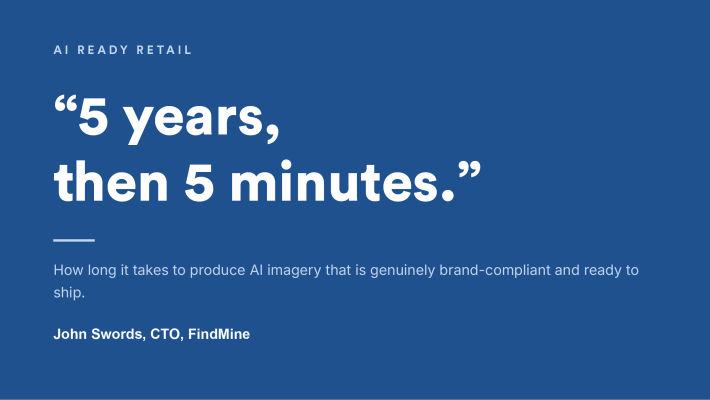
I asked FindMine's CTO, John Swords, a while back how long it takes us to produce AI imagery that's genuinely brand-compliant and ready to ship for an iconic and elevated brand like a Gap or lululemon. His answer: "5 years, then 5 minutes." I used that line in a post about AI imagery once, and everyone latched onto the "five minutes" part. But the five years is the interesting number. And it isn't five years of building a model. That part got commoditized. It's five years of gathering the inputs and breaking the ties. Five years of a real visual merchandiser looking at a real window display and saying yes, no, not with those shoes, never that print in July. Five years of getting it right, getting it wrong, and writing down the difference in a form the machine can use as a cogent prompt it knows what to do with.
At-bats you cannot buy, scrape, or prompt
I had our team pull our own numbers recently for a deck. Even I had to sit with them for a second:
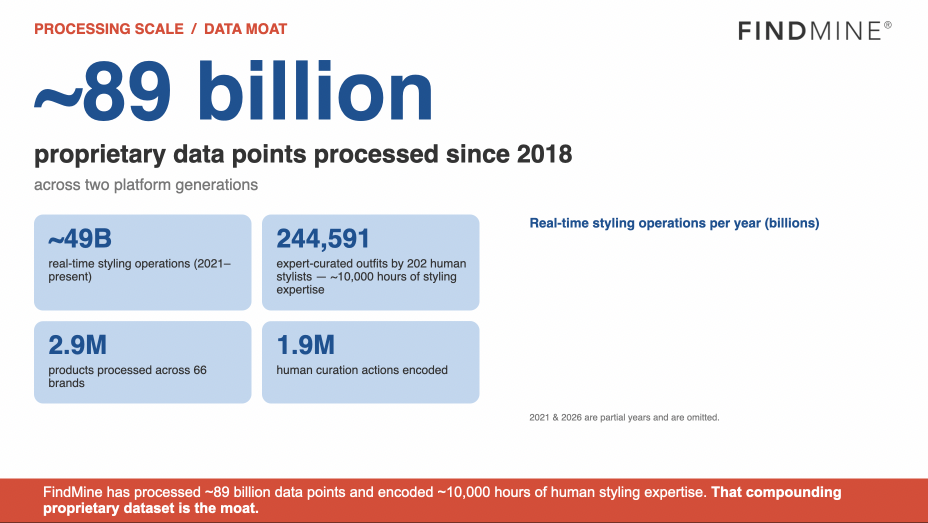
While this exercise was frustrating in that the data has lived in many different platforms over the years, with different definitions, making it challenging to concatenate a full picture (getting your data house in order is another AI challenge that's a topic for another day!), those aren't vanity metrics. They're at-bats. You cannot buy them, scrape them, or prompt your way to them. They are the accumulated record of a decade of someone with taste making a call, with the machine watching them make it. Start today with the best model money can buy and the sharpest data science team in retail, and on day one you have zero of them. Not fewer. Zero.
The market is finally catching up
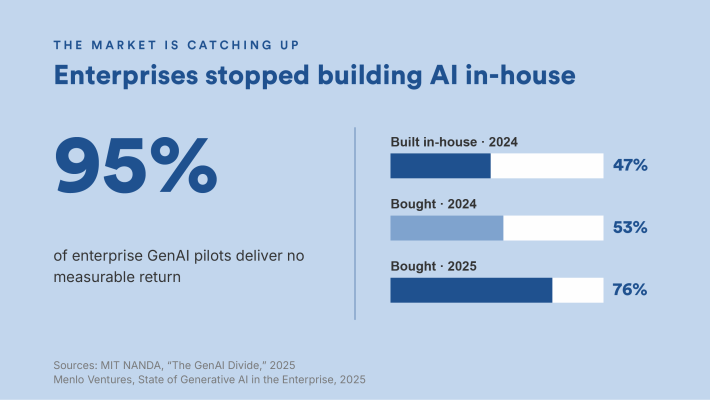
The market is finally catching up to this. Massachusetts Institute of Technology's NANDA initiative studied 300 enterprise AI deployments this year and found that 95% of generative AI pilots deliver no measurable return, and that the builds most likely to stall are the ones companies try to do entirely in-house. Internal builds succeeded about a third as often as buying or partnering. Menlo Ventures put a number on the retreat: in 2024, enterprises built 47% of their AI use cases themselves; in 2025 that flipped, and 76% are now bought. Andreessen Horowitz's read on why is the cleanest I've seen. As the models themselves turn into a commodity, the only moat left standing is proprietary data that feeds the models. The scarcity moved. It's no longer in the model. It's in what you feed it.
Why the question is still worth asking
Now, in defense of the build-it-yourself crowd, because I've watched enough of them to have real sympathy: they are not foolish to ask the question. Every serious retailer should go through the exercise of deciding whether it wants this badly enough to own it. That's a healthy instinct, and I'd be suspicious of a team that didn't have it. What I've seen, over and over, is what happens next. Priorities shift. It turns out to be far more complicated than the Q3 plan assumed. The data science team gets pulled onto whatever the CEO cares about more this quarter. And the styling project quietly never ships. Not because anyone failed at their job. Because the thing they were actually trying to build was ten years of judgment, and you can't sprint that.
Build-or-buy was never binary
For the build-in-house crowd that truly has the long-term capacity to own it: My best advice is to not think of build-or-buy as a binary. You define and own what is most important to you:
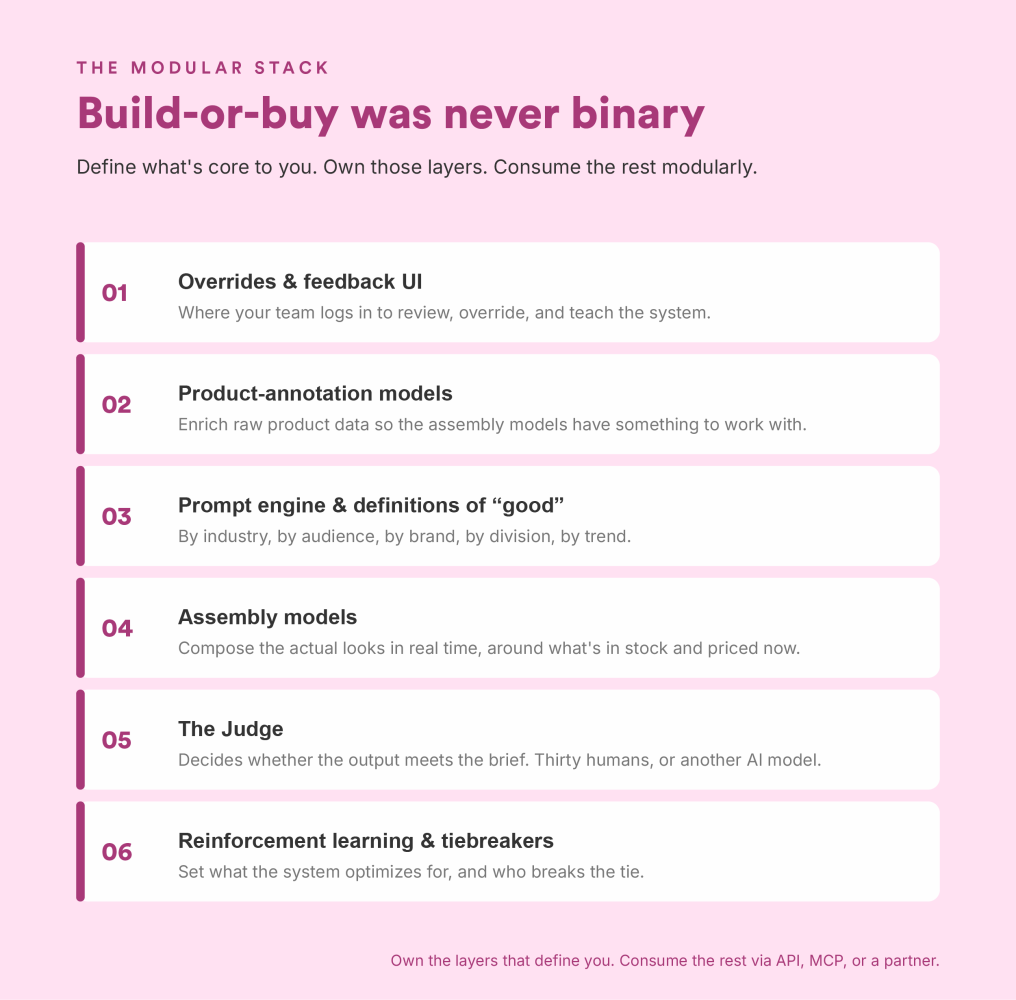
After answering those questions, some of the stuff you're going to "own in house" inevitably will go to third parties anyway (Google, OpenAI, another contractor or vendor whose services you consume via API or MCP, or whose code you pull from a repo), and everything left over then will need to be done by someone or some service externally.
That's the model we encourage our most technically capable customers to choose. For years at FindMine, we had to fit our AI into a SaaS box because that's what the market wanted - an end-to-end platform you log into, and it does everything for you. And we got really good at that - the AI was underneath layers of dashboards and WYSIWYG editors. But 10 years later we finally get to be what we truly are - an AI company. You can consume any part of our offering modularly - just the Judge model, for example, the prompt engine, or the assembly, etc.
However, some brands still need an end-to-end SaaS platform to run the show because they don't have the technical capacity or the long-term attention to execute even segments of the process, and they have other, more critical priorities to focus on internally. There is NO shame in that - after all, retailers who think of themselves as tech companies rapidly fell out of favor, and the wave of a return to retail fundamentals is what has buoyed many brands to their greatest heights.
Change the question
If you're the one in the nice conference room, change the question. Don't ask, "Can we build a model that styles outfits and generates the imagery?" You can. Everyone can now. That's not where the advantage lives. Ask instead:
"Do we have ten years of encoded brand judgment sitting in a database somewhere, with a real merchandiser's yes-or-no attached to every single call?"
If the answer is no, you're not deciding whether to build. You're deciding whether to spend the next decade acquiring something you could have on Monday. Know who you are, and then decide: build-and-partner, or buy. That's your fastest path to success.
You can absolutely build it yourself. I just want you to know what "it" is before you start the clock.

Michelle Bacharach is the CEO and Founder of FindMine, an AI platform that helps enterprise retailers build the content infrastructure their brands need to show up in search, in AI-powered shopping, and at every point a customer is ready to buy. Top brands use FindMine to automatically generate on-brand, inventory-aware curation and creative at scale (100M consumers a month see FindMine's content). With 15 years of product leadership at the intersection of retail and technology, Michelle has become one of the more direct voices on what it actually takes for brands to compete in an AI-first commerce environment, speaking at National Retail Federation's Big Ideas Keynote, SXSW, and HumanX, and appearing in Forbes, Vogue Business, and Daily Women's Wear. She is an Inc. Magazine Top 200 Female Founder and holds the Retail TouchPoints 40 Under 40 distinction.