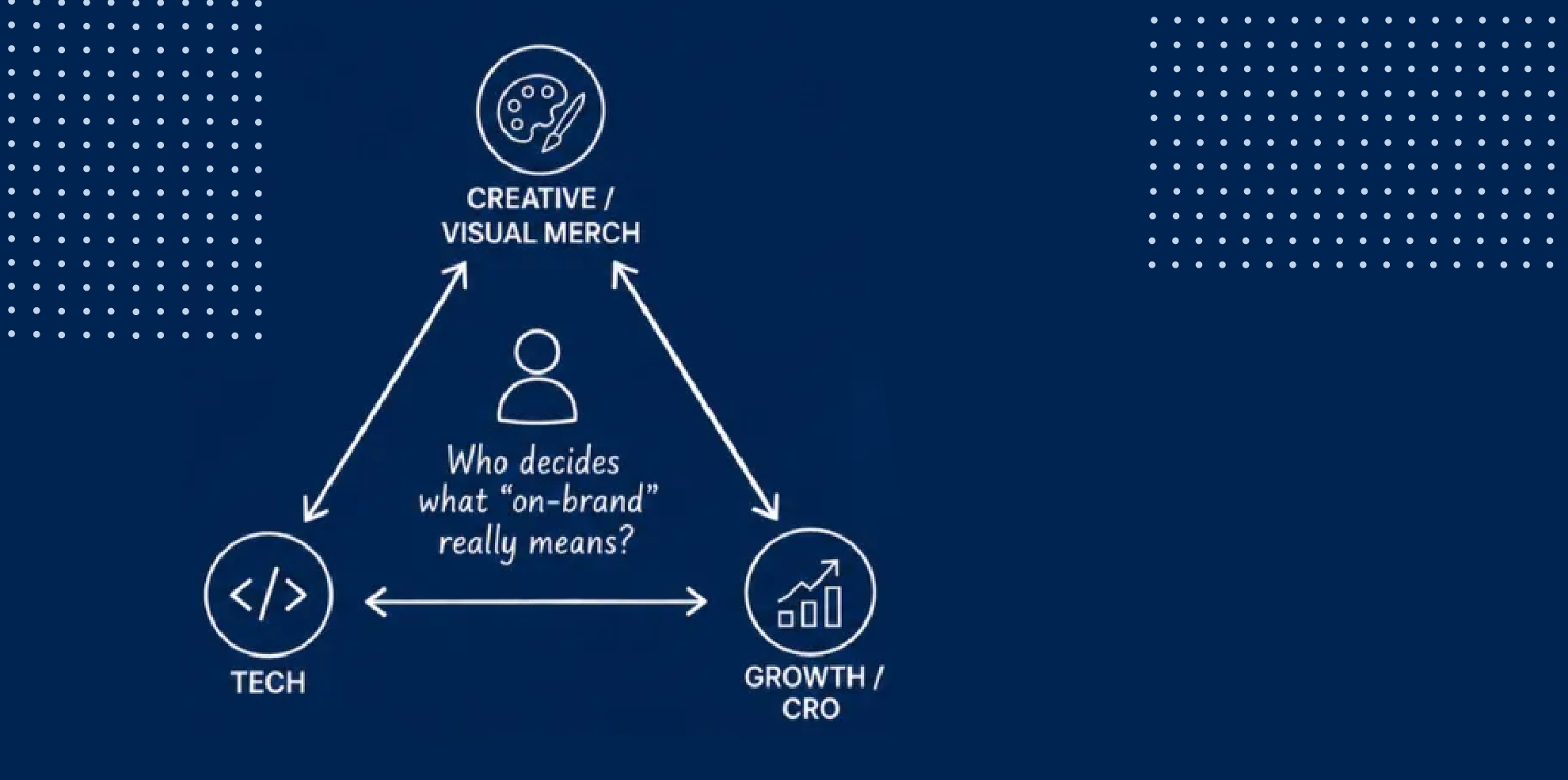
This article is a follow-up to the previous AI Ready Retail edition, "What Actually Happens When You Hand Your Brand Aesthetic to Generic AI".
Last time I told you that the last 20% of an AI stylist isn't a technology problem. I promised I'd tell you what it actually is. Here it is: it's an org chart problem wearing a technology disguise.
I've now watched dozens of retailers go through an AI styling rollout, and I've come to believe you learn more about a company in the first six weeks of one of these projects than you would from a million-dollar consulting engagement.
The slide deck that a strategy firm hands you tells you who the company says it is.
An AI styling project tells you who it actually is:
- Who holds the power.
- Who's afraid.
- Whose eagerness will derail progress.
- Who quietly runs everything.
Because the moment you try to teach a model what "on brand" means, every unspoken assumption in the building has to be said out loud. And that is where it gets interesting.
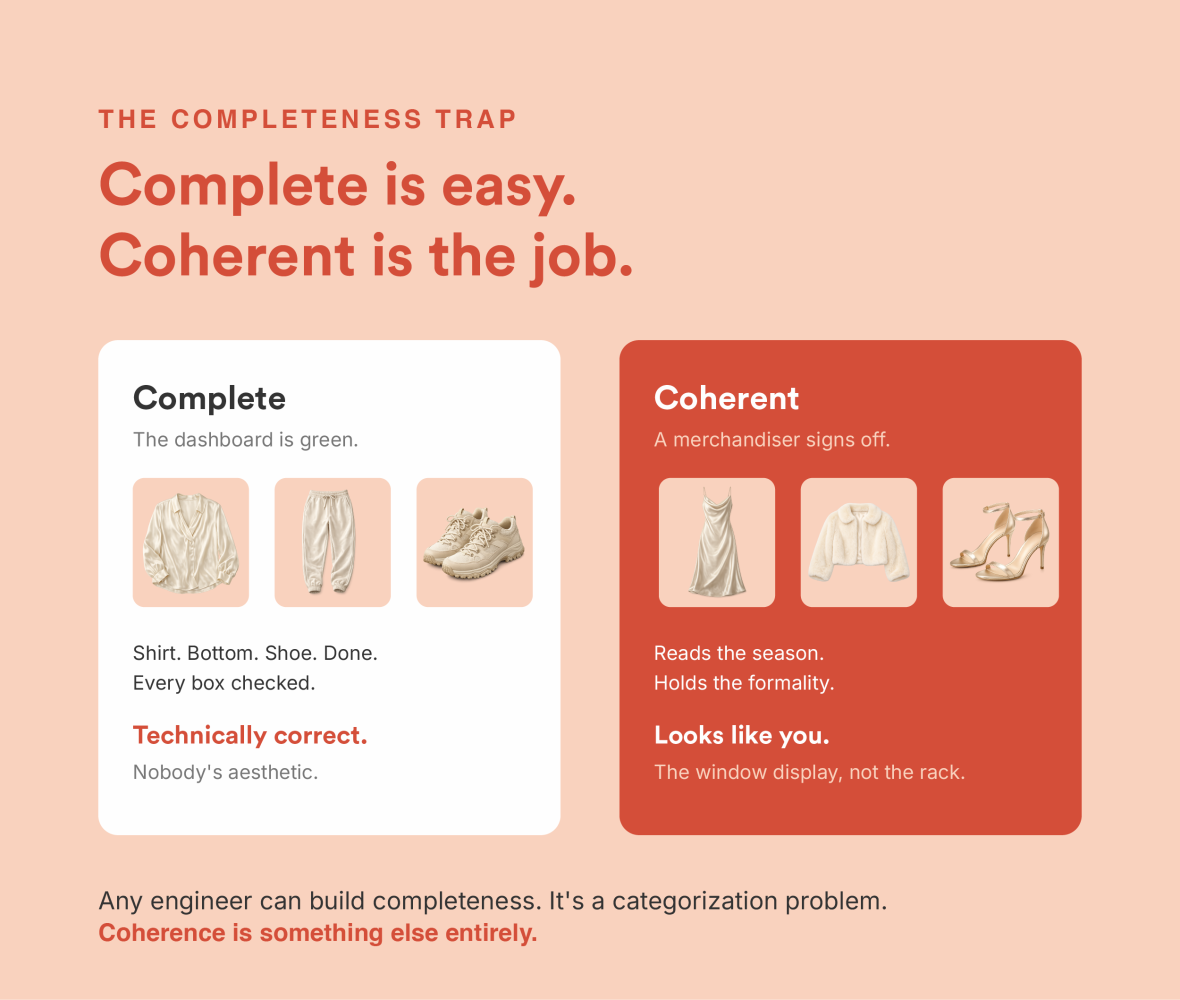
The model on the left isn't broken. It did exactly what it was told. That's the scary part. Coherence is the thing you can't put in a ticket.
The power audit happens whether you want it to or not
Nobody warns you going into these projects that defining coherence for a machine forces a company to answer a question it has spent years avoiding: who actually decides what we look like?
In most retailers, there are at least three teams that believe the answer is "me." Tech owns the pipeline and the dashboards, so tech assumes it owns the output. Creative and visual merchandising owns the aesthetic, so they assume they own the verdict. And then there's the conversion-rate-optimization crowd, the growth and performance-marketing folks, who own the number the CEO actually asks about on Monday, so they assume they own the tiebreaker.
For years, these three could coexist because the order of operations was linear: The stylist styled. The engineers shipped. The CRO team optimized. Nobody had to reconcile their definitions of "good" because nothing forced the collision.
An AI styling project forces the collision. Immediately. You cannot prompt a model with three contradictory definitions of "on-brand" and expect one coherent look out the other side. So the first thing the project surfaces, usually within the first two meetings, is which of those three teams actually has the power. Not on the org chart. In the room.
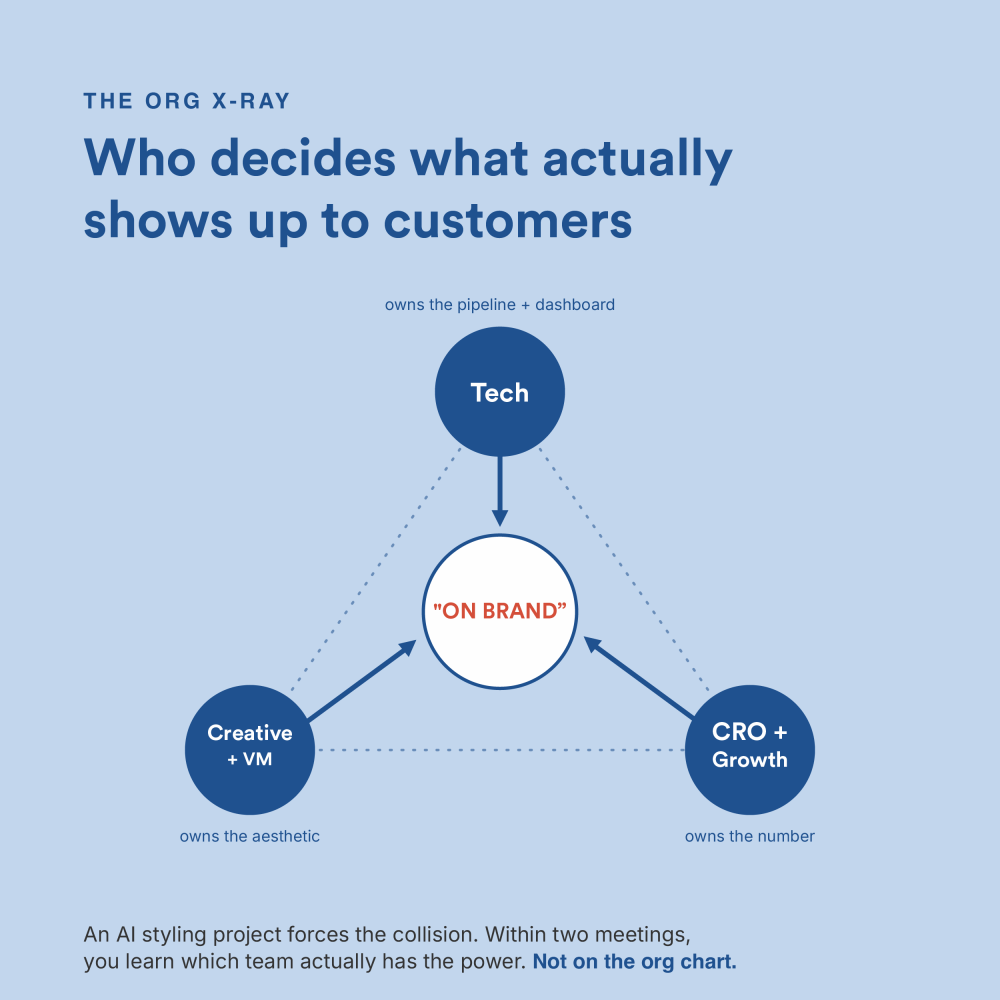
Nobody draws this triangle on a slide. But it's real, and the project makes it visible. The fastest way to find the true center of gravity: watch who gets cc'd on the "is this on-brand?" email, and who actually replies.
I've watched the CRO team win that fight, and the looks get a little safer, a little more "this converts," and a little less "this is who we are." I've watched creative win it, and the output gets gorgeous and aspirational, occasionally ignoring what's in stock and limited in its prevalence. I've watched tech win it, and you get something complete, categorized, defensible, and soulless. Who wins tells you everything about what that company actually values, regardless of what's printed in the brand book.
"It's just a recommendation engine"
The single fastest way to read an organization is to listen for who calls it a recommendation engine.
That phrase is a tell. The person who says "oh, it's basically a rec engine, like customers-also-bought" is telling you they think styling is a categorization problem. Shirt, bottom, shoe, done. They are, usually, an extremely competent person who has simply never had the job of deciding whether a silk slip dress works with a puffer this season. To them the green textured suit plus sweatpants isn't a disaster, it's a successful query. Bottoms were found.
And then there's the merchandiser, the stylist, the person with the eye, who hears "recommendation engine" and physically flinches. Because they know the difference between a rack of clothes and a window display. One is complete. The other is curated. They serve different functions, and only one of them is the brand.
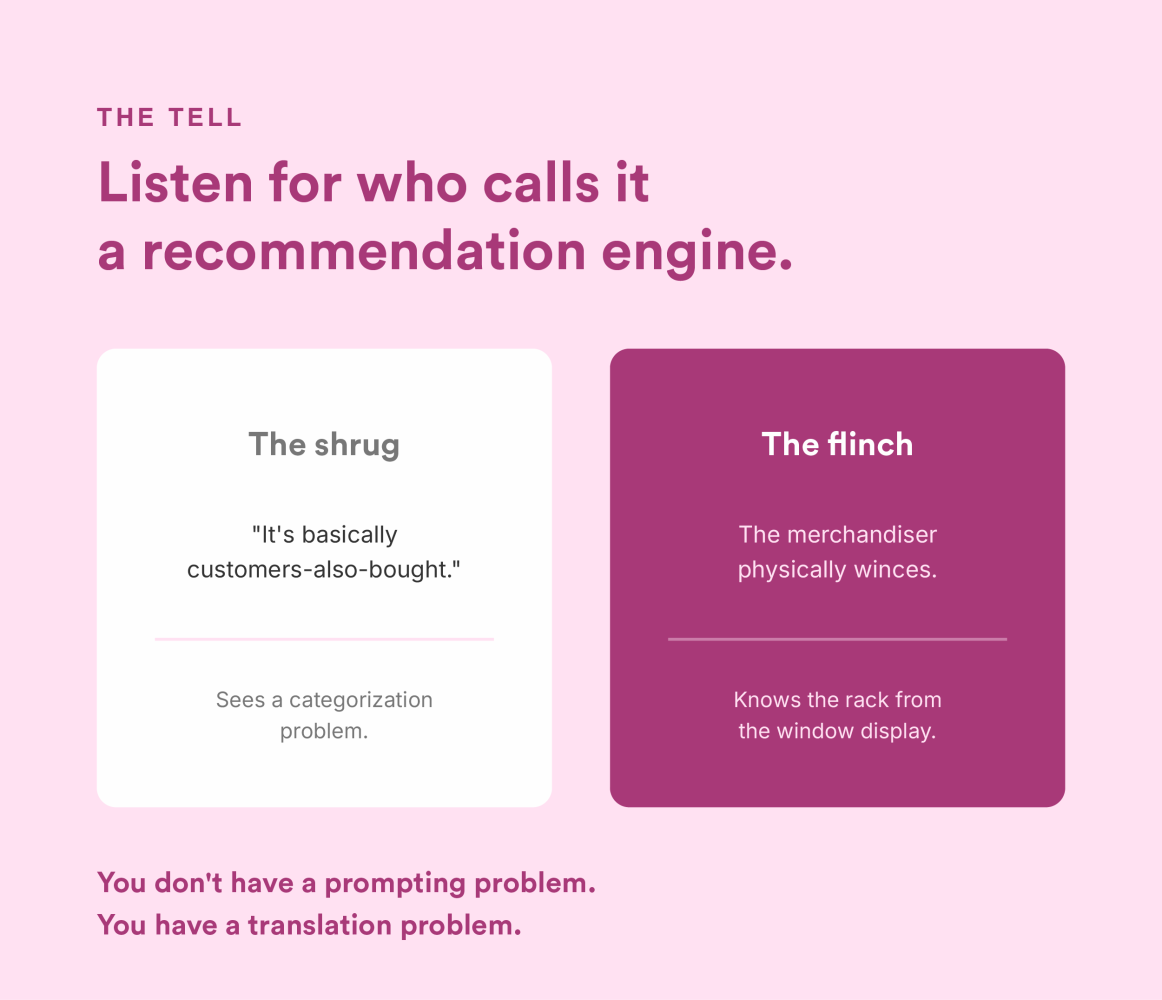
You can run this test in any kickoff meeting. Say "recommendation engine" out loud and watch the faces. The shrug and the flinch will be sitting at the same table, and whether they report to the same person decides most of what happens next.
The gap between those two people is the whole project. If they report to the same VP and that VP gets it, you're going to be fine. If they're in different orgs that meet twice a quarter and quietly resent each other, no model on earth is going to save you, because you don't have a prompting problem, you have a translation problem between two people who don't share a language.
Who's comfortable, and who's white-knuckling
The other thing these projects reveal fast: who is actually comfortable working in a new way, and who is performing comfort while white-knuckling the old one.
How to spot it: The merchant who's genuinely game treats the model like a sharp, fast, slightly feral junior stylist in need of training. They feed it feedback, they get specific, they learn that "make it more elevated" means nothing, and "swap the sneaker for a loafer when the bottom is tailored" means something. They master the translation. They get faster every week.
Then there's the person who treats every output as a threat. They over-correct. They manually override looks and don't tell anyone, and three weeks later, an exec complains about "the AI's terrible outfit" that was, in fact, hand-built by their own team member who was trying to protect their turf. There was no prompt. Just a human quietly fighting the system and blaming the system for the fight. You can teach a model bad habits this way, too, by feeding it wayward manual inputs that one team swears are on-brand, and another team would never sign off on. Sometimes the human isn't even fighting - they just didn't get the primer on HOW to use a tool like this, so they defaulted to how they use a recommendation engine or other tech solution, not knowing that the paradigm must be entirely different.
None of that is a model failure. It's a change-management failure. And it was visible from week one to anyone watching the people instead of the dashboard.
Start with the change management, not the model
So here's where I've landed, and it's the opposite of how most retailers sequence these projects.
Everyone wants to start with the technology. Stand up the pipeline, connect the catalog, generate the first looks, see the green dashboard. The change management gets treated as a rollout afterthought, a training session you bolt on at the end. Backwards. The technology is the easy 80% you can build in four days. The people are the 20% that takes three years.
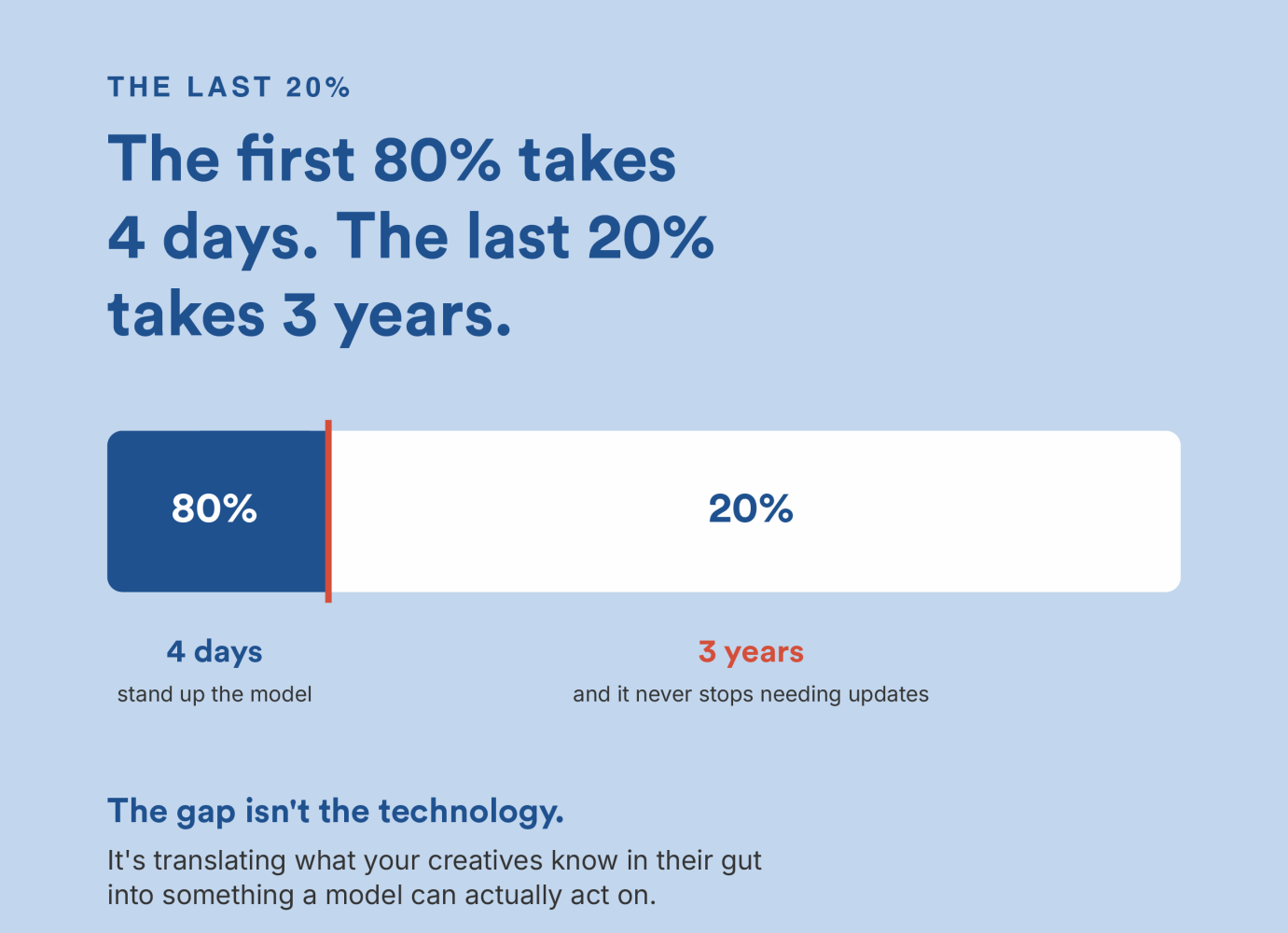
The first version demos beautifully in week one. That's the trap. The three years isn't model training — it's the slow work of getting your stylists' taste out of their heads and into something the system can repeat without them in the room.
Start with the people. Before a single look is generated, get the three teams in a room and have them say out loud to each other what on-brand actually means and who breaks the tie when they disagree. Educate everyone on what this tool is and, just as importantly, what it isn't. It is not a recommendation engine. It is a junior stylist who works at an impossible scale and needs your taste encoded into it. Then do the hard, unglamorous work of mastering the translation: turning the things your creatives know in their gut into instructions a model can actually act on, so that "too many cooks" never becomes the thing that breaks your output.
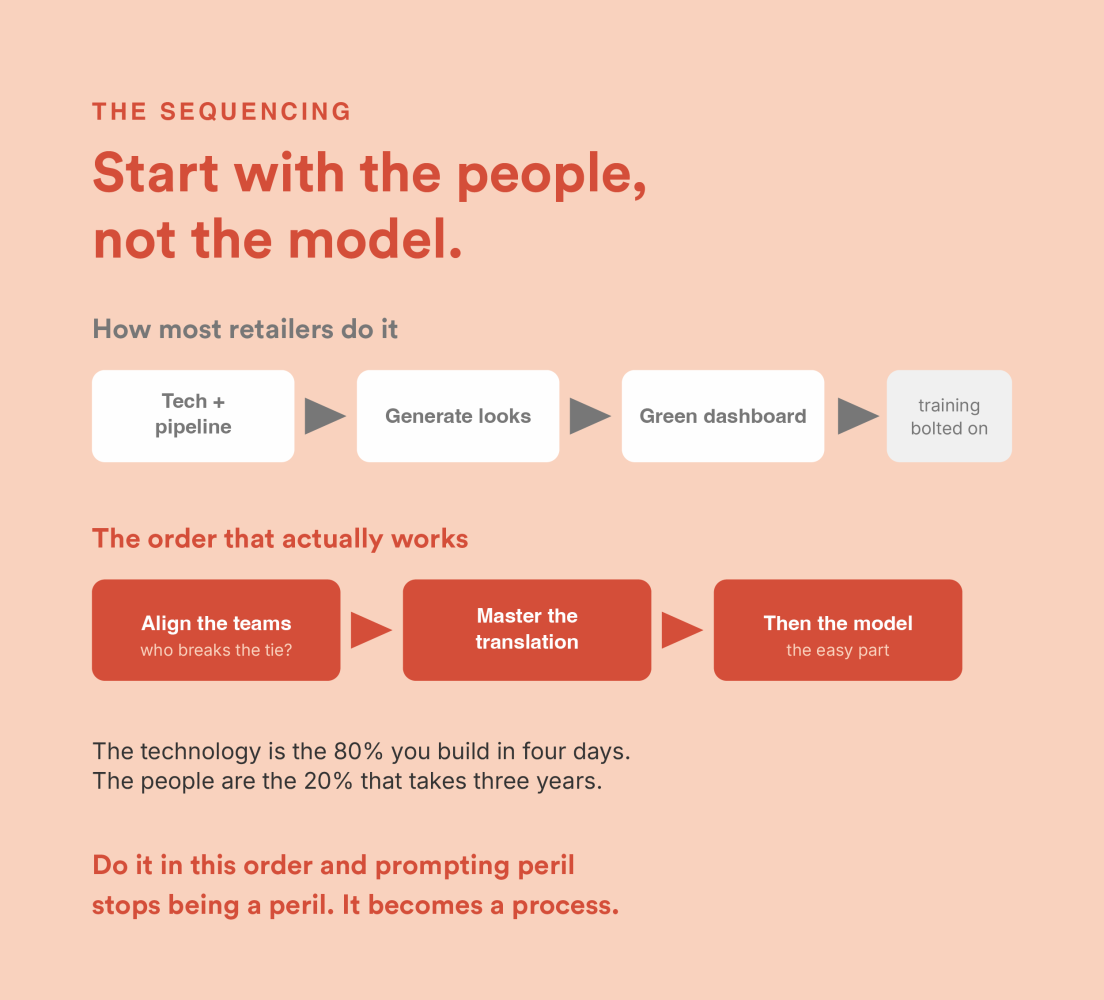
Most teams sequence it top-to-bottom and treat alignment as a launch-week training. Flip it. The expensive lesson is that you can't prompt your way out of a disagreement the org never resolved.
Do that, and prompting peril stops being a peril. It becomes a process.
I'm only half joking when I say a styling project is cheaper and more honest than a strategy audit. A consultant interviews your executives and writes down what they tell her. An AI styling project makes your organization show you who it is, in real time, under a little bit of pressure, with the receipts on a dashboard. Nobody can perform their way through it.
So if you're about to roll one of these out, watch the people, not just the pixels. The project will tell you things about your company you've been paying a lot of money not to find out.
The hidden trap that will remain unsolved: sometimes even your best people can't describe your brand in natural language. Because most LLMs use natural language as the way to prompt the model for output, this presents a big problem. It's not a failure of your people - it's endemic to fashion, home, beauty, and any industry where taste and aesthetic have a certain je ne sais quoi. Having that ineffable quality and differentiation is a feature, not a bug for a successful fashion brand for example. But it presents a big problem for successfully rolling out any AI strategy that automates creation of creative pursuits - styling, ad creative, etc. More on how to overcome that one next!

Michelle Bacharach is the CEO and Founder of FindMine, an AI platform that helps enterprise retailers build the content infrastructure their brands need to show up in search, in AI-powered shopping, and at every point a customer is ready to buy. Top brands use FindMine to automatically generate on-brand, inventory-aware curation and creative at scale (100M consumers a month see FindMine's content). With 15 years of product leadership at the intersection of retail and technology, Michelle has become one of the more direct voices on what it actually takes for brands to compete in an AI-first commerce environment, speaking at National Retail Federation's Big Ideas Keynote, SXSW, and HumanX, and appearing in Forbes, Vogue Business, and Daily Women's Wear. She is an Inc. Magazine Top 200 Female Founder and holds the Retail TouchPoints 40 Under 40 distinction.